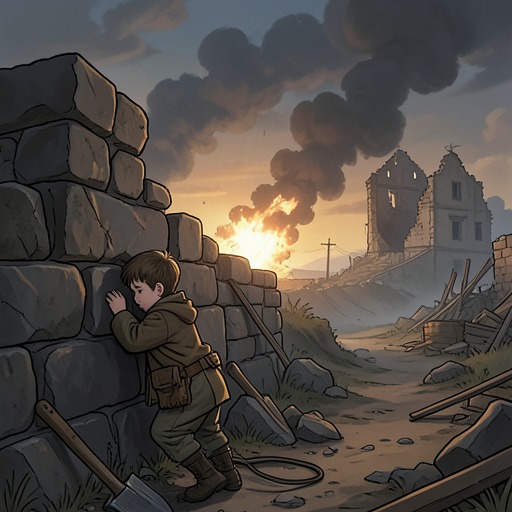
1940 Cairnholm Island Air Raid
Miss Peregrine's Home of Peculiar ChildrenThe 1940 Cairnholm Island Air Raid was the German attack that destroyed the orphan home on September 3, 1940, and left Abraham Portman as its sole surviving child. It explains the gap between his childhood stories and the history behind them: the monsters were partly a disguised account of human persecution, while the island home’s apparent enchantment preserved the truth of a refuge amid war. Decades later, the date also became Jacob Portman’s clue that the island’s past was not merely a story but a day preserved inside Miss Peregrine’s time loop.
Background and Target
During the Second World War, Cairnholm had an anti-aircraft gun battery at the far end of the island, beyond the wood where the orphan home stood. That installation made the island a military target. Local recollection described the air raids as a continuing threat: sirens sounded, people hurried to shelter, and a volunteer air-raid warden checked that window shades were drawn and streetlights extinguished. The islanders prepared for attack but expected the mainland’s ports and factories to attract greater attention.
On the night of the raid, German bombs fell on Cairnholm. The gun crew returned fire, and the town itself suffered no deaths, but one bomb went off course and struck the orphan home. The distinction between the defended military position and the children’s home proved fatal: the stray bomb killed the young residents and those caring for them. In the local account, one bomb was enough to end the home.
The Attack and Abraham’s Survival
Oggie remembered the attack as an extended bombardment and identified its exact date as September 3, 1940. The following morning, a young man walked into town without apparent injury. He was the only survivor of the orphan home, and the person he described as having seen his companions die was Abraham Portman. He asked when the next boat would leave for the mainland, intent on joining the fight against those who had killed his people.
Abraham was twelve when his family had sent him from Poland to Britain with a suitcase and the clothes he wore. He had left on a one-way journey and never saw his parents, older brothers, or extended family again; they were killed before he turned sixteen. On Cairnholm, the bombing added the loss of his orphan-home companions to the earlier destruction of his family. The air raid therefore marked not only a mass death but the end of the temporary refuge that had taken him in.
The Date Reappears
Years later, Jacob heard the local account while searching for people who might have lived at the ruined home. The exact date, September 3, 1940, recalled the final words of his grandfather, who had died after telling him to find the bird in a loop on the other side of the old man’s grave. Jacob then saw a calendar marked September 1940, with the first two days crossed out. The date and calendar allowed him to recognize that he had entered a place where September 3, 1940, was still recurring.
The air raid’s date thus has two functions in the narrative. It records the historical destruction that ended the orphan home, and it identifies the day held within Miss Peregrine’s time loop. The calendar transforms a report about the island’s past into evidence Jacob can see in the present; his grandfather’s directions, previously obscure, become literal instructions leading to the loop.
Historical Meaning and Aftermath
As a child, Jacob had heard Abraham’s accounts of monsters as frightening stories about invisible pursuers and fantastical creatures. He later understood that the tale of being hunted in Poland had a historical truth: Abraham’s family had been caught in Nazi persecution, and the supposed monsters were human beings in uniform. The island home’s magical qualities were likewise a way of retelling something real. Its children were Jewish orphans of war, and their escape from persecution was extraordinary without requiring supernatural powers.
The account of the bombing sits within that larger history of overlapping losses. Miss Peregrine later described Abraham as having faced persecution as a Jew and as a peculiar, and explained that after the war he returned changed, determined to live outside the loop rather than remain hidden. His survival of the raid did not restore what had been taken from him; it sent him onward alone, carrying the memory of those he had lost. Jacob’s later recognition of the date reconnects that concealed family history to the island’s physical ruins and to the repeating day that preserved the home’s last morning.